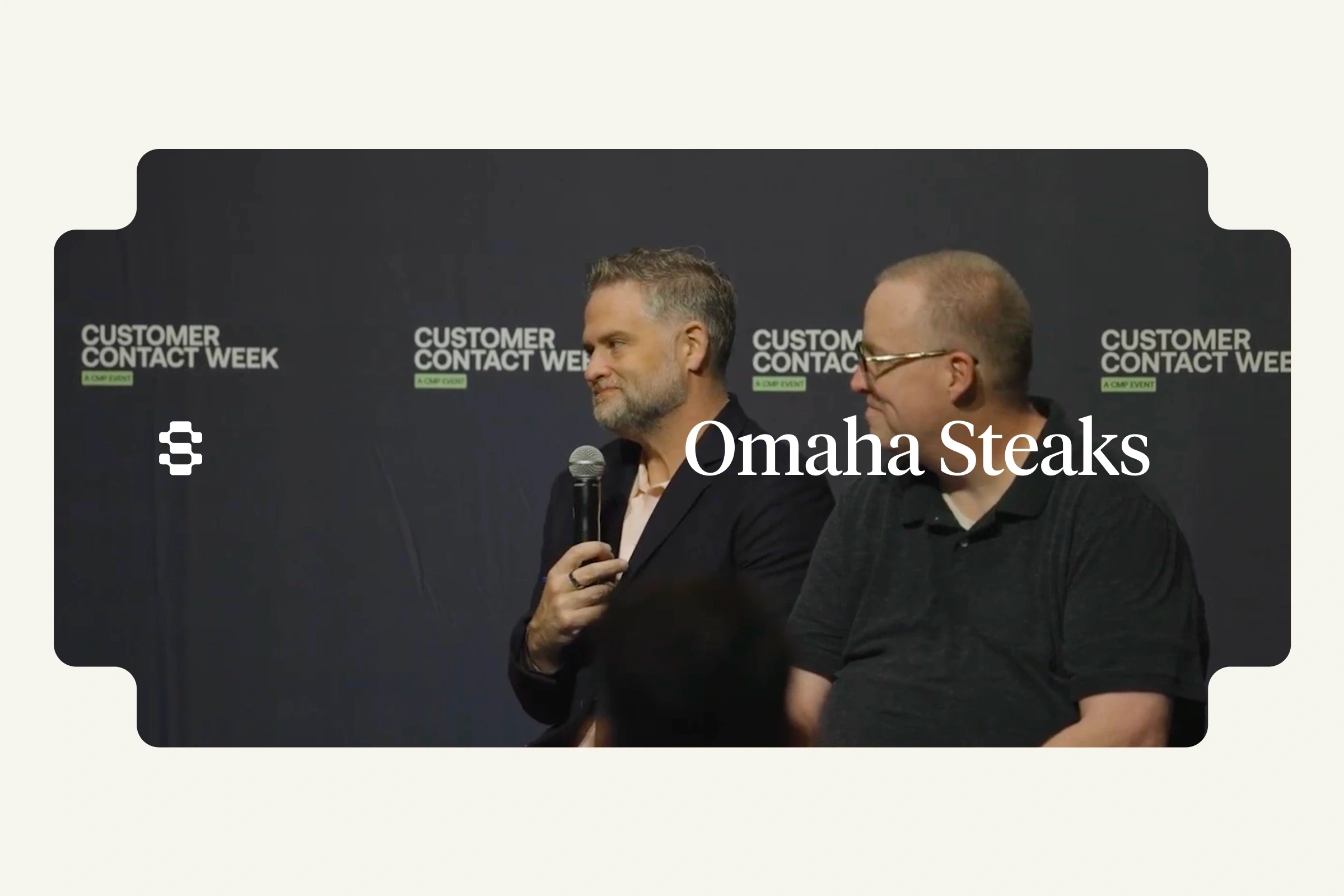
How Omaha Steaks turned its inbound line into a sales engine
Holden Lewis
Omaha Steaks has been selling premium steaks and seafood for 109 years. Half of its annual call and chat volume arrives in a single month. From the week before Thanksgiving through mid-December, volume runs 12 times higher than steady state, because everyone wants to send steaks as a holiday gift.
For years, the company solved that spike with bodies. It hired around 5,000 seasonal workers starting each September to end up with roughly 2,000 actually taking calls by December. Training started in mid-September and ran as a revolving door: hire, train, quit, rehire. Supervision stretched from one supervisor per 20 agents to, at the worst point, one per 212.
Grant Young, who runs contact center operations at Omaha Steaks, describes the old holiday season simply: a disaster every year, and a disaster that produced half the company’s revenue. Getting it right was never optional.
The first attempt: build it in-house
Before working with Simple AI, the Omaha Steaks team built its own virtual agent on the tools inside its CCaaS platform. Grant, an analyst, and a group of developers spent six months on it. The model was deterministic, so every path had to be mapped by hand, and a caller saying “my address is” in the wrong spot could throw the whole flow off.
The result was 20% containment on a single use case. Useful, but nowhere near the seasonal problem, and expensive to maintain for a team whose members were not AI specialists.
The pilot: signed June 2, live June 10
When Omaha Steaks evaluated vendors, the bar was set by its customer experience standards: the agent had to hold a natural conversation rather than walk a script tree, it had to complete real work end to end, and it had to sound good enough to represent a premium brand.
The team started narrow on purpose. Omaha Steaks runs dedicated phone numbers for its mailers, so a caller on one of those lines is almost certainly ordering the package from the mailer. That system offered Simple a contained first use case that still finished the job: take the order, place it in the order system, no human touch.
Simple flew to Omaha and worked alongside Grant’s team for two weeks. The proof of concept was signed on June 2. First live calls happened June 10. That eight-day window included new APIs on the Omaha Steaks side, since the company runs their business on a homegrown order and CRM stack rather than an off-the-shelf platform.
Day one containment was 52%. Grant’s first reaction was alarm: was the new system was hanging up on customers? (It wasn’t.) Three weeks in, containment held steady at 60%.
"The first day we had it on, we were at 52% containment. I was just like, are we hanging up on customers? No."
Grant Young
Director of CEC Operations, Omaha Steaks
Crawl, walk, run
From there the rollout followed a waterfall: while one use case moved to production, the next was in configuration. The single-package line expanded to roughly 100 products, searchable by item number or name. A month of testing later, in September, the team turned the agent loose on 100% of traffic.
The agent, named Simone after the founding Simon family, now greets every caller, understands why they’re calling, and either handles the call or routes it with full context. Sales came first. Service calls that need a more careful touch, like claims and delivery problems, are rolling out now.
The numbers after one year
Containment: 60% across all calls, 70 to 75% on the dedicated sales lines, and 75% on chat.
Abandonment: 16% two years ago, 9% a year ago, 3% today.
Upsell rate: Simone runs an upsell rate of 28% to 30%, compared to the 22% of seasonal agents.
Seasonal hiring: from 5,000 hires down to 1,500 trained last holiday, with 692 planned for this year.
Average order value tells the same story. Callers who complete an order with Simone match the numbers of tenured agents, and because far fewer calls abandon, more calls become orders at all.
"It turns out that the virtual agent's much better at selling a dessert to someone than I am."
Grant Young
Director of CEC Operations, Omaha Steaks
Why it worked
Three decisions mattered more than any feature.
First, Omaha Steaks framed the project around revenue rather than deflection. The inbound line is where the company sells, so the goal from day one was completed sales rather than contained calls.
Second, both teams treated it as a partnership. A year in, the teams still meet two to three times a week, and each side has flown to visit the other. Deployment in ten days only happened because Omaha Steaks gave the project engineering resources and decision-makers, and Simple put dedicated agent engineers on their account.
Third, the rollout was incremental. One contained use case, proven end to end, then the next. Nobody just flipped a switch on day one.
If your busiest month is also your most error-prone month, the Omaha Steaks playbook is worth copying: pick the narrowest use case that still finishes a revenue task, prove it in weeks, and expand from there.
To learn more about how Simple AI can help your business, request a demo.
Omaha Steaks has been selling premium steaks and seafood for 109 years. Half of its annual call and chat volume arrives in a single month. From the week before Thanksgiving through mid-December, volume runs 12 times higher than steady state, because everyone wants to send steaks as a holiday gift.
For years, the company solved that spike with bodies. It hired around 5,000 seasonal workers starting each September to end up with roughly 2,000 actually taking calls by December. Training started in mid-September and ran as a revolving door: hire, train, quit, rehire. Supervision stretched from one supervisor per 20 agents to, at the worst point, one per 212.
Grant Young, who runs contact center operations at Omaha Steaks, describes the old holiday season simply: a disaster every year, and a disaster that produced half the company’s revenue. Getting it right was never optional.
The first attempt: build it in-house
Before working with Simple AI, the Omaha Steaks team built its own virtual agent on the tools inside its CCaaS platform. Grant, an analyst, and a group of developers spent six months on it. The model was deterministic, so every path had to be mapped by hand, and a caller saying “my address is” in the wrong spot could throw the whole flow off.
The result was 20% containment on a single use case. Useful, but nowhere near the seasonal problem, and expensive to maintain for a team whose members were not AI specialists.
The pilot: signed June 2, live June 10
When Omaha Steaks evaluated vendors, the bar was set by its customer experience standards: the agent had to hold a natural conversation rather than walk a script tree, it had to complete real work end to end, and it had to sound good enough to represent a premium brand.
The team started narrow on purpose. Omaha Steaks runs dedicated phone numbers for its mailers, so a caller on one of those lines is almost certainly ordering the package from the mailer. That system offered Simple a contained first use case that still finished the job: take the order, place it in the order system, no human touch.
Simple flew to Omaha and worked alongside Grant’s team for two weeks. The proof of concept was signed on June 2. First live calls happened June 10. That eight-day window included new APIs on the Omaha Steaks side, since the company runs their business on a homegrown order and CRM stack rather than an off-the-shelf platform.
Day one containment was 52%. Grant’s first reaction was alarm: was the new system was hanging up on customers? (It wasn’t.) Three weeks in, containment held steady at 60%.
"The first day we had it on, we were at 52% containment. I was just like, are we hanging up on customers? No."
Grant Young
Director of CEC Operations, Omaha Steaks
Crawl, walk, run
From there the rollout followed a waterfall: while one use case moved to production, the next was in configuration. The single-package line expanded to roughly 100 products, searchable by item number or name. A month of testing later, in September, the team turned the agent loose on 100% of traffic.
The agent, named Simone after the founding Simon family, now greets every caller, understands why they’re calling, and either handles the call or routes it with full context. Sales came first. Service calls that need a more careful touch, like claims and delivery problems, are rolling out now.
The numbers after one year
Containment: 60% across all calls, 70 to 75% on the dedicated sales lines, and 75% on chat.
Abandonment: 16% two years ago, 9% a year ago, 3% today.
Upsell rate: Simone runs an upsell rate of 28% to 30%, compared to the 22% of seasonal agents.
Seasonal hiring: from 5,000 hires down to 1,500 trained last holiday, with 692 planned for this year.
Average order value tells the same story. Callers who complete an order with Simone match the numbers of tenured agents, and because far fewer calls abandon, more calls become orders at all.
"It turns out that the virtual agent's much better at selling a dessert to someone than I am."
Grant Young
Director of CEC Operations, Omaha Steaks
Why it worked
Three decisions mattered more than any feature.
First, Omaha Steaks framed the project around revenue rather than deflection. The inbound line is where the company sells, so the goal from day one was completed sales rather than contained calls.
Second, both teams treated it as a partnership. A year in, the teams still meet two to three times a week, and each side has flown to visit the other. Deployment in ten days only happened because Omaha Steaks gave the project engineering resources and decision-makers, and Simple put dedicated agent engineers on their account.
Third, the rollout was incremental. One contained use case, proven end to end, then the next. Nobody just flipped a switch on day one.
If your busiest month is also your most error-prone month, the Omaha Steaks playbook is worth copying: pick the narrowest use case that still finishes a revenue task, prove it in weeks, and expand from there.
To learn more about how Simple AI can help your business, request a demo.


