CCW Vegas 2026: CX Buyers Are Done With Mediocre AI

Holden Lewis

Customer Contact Week Vegas ran on a contradiction this year. Companies are more open than ever to implementing AI, but are also more skeptical than ever of the solutions on the market. Nowhere was this more apparent than in the voice AI category. According to a CMP survey, 4 out of 5 CX leaders say they're open to investing in voice AI, but only 37% are prioritizing it — a 10% decrease from the previous year.


The exception was on our own stage: Grant Young, Director of CEC Operations at Omaha Steaks and Simple AI customer, shared a containment number most of the audience could only dream of: 75% on their highest-value calls, compared to 20% with the system they used a year ago. Back at the booth, almost every conversation circled the same gap between what voice AI buyers were promised and what most of them got.


The most common conversation at our booth: searching for a new voice AI vendor


Rather than shopping for their first voice AI, the buyers we spoke to were most often looking to replace their existing solution. These companies had bought an early agentic voice product, as a module within a legacy platform or one of the first-generation voice vendors, and the results fell short of expectations.


We heard the same two things all week: hopeful about voice AI, unhappy with their current setup. These buyers have been burned, and they show up expecting the next vendor to miss the nuances of their business too. They won't be won over by another pitch, only by results.


Results are exactly what Omaha Steaks brought to their session.

Omaha Steaks and the containment numbers that shook the room


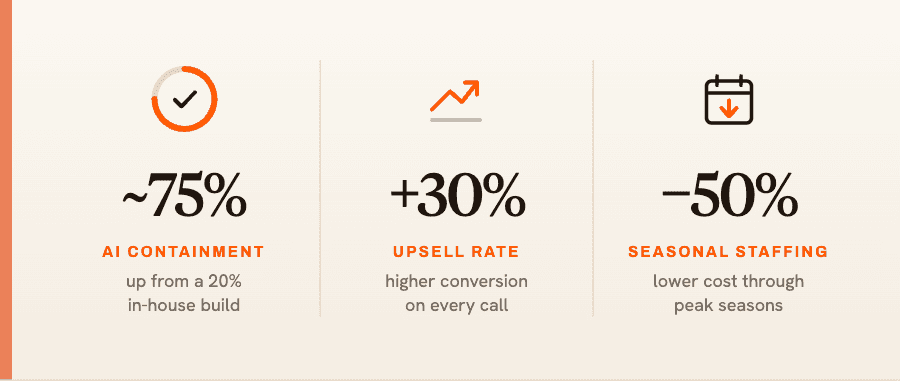
Grant Young and Rob Bradshaw of Omaha Steaks told their story on stage Thursday. They shared their containment on inbound sales calls: 55% in the first week, around 60% across the board now, and peaking near 75% on certain use cases.


When they dropped those numbers, the room gasped. Grant and Rob also could not believe it when the first numbers using Simple's voice agent came in:

"The first day we had it on, we were at 52% containment. I was just like, are we hanging up on customers? No."

Grant Young

Director of CEC Operations, Omaha Steaks


Some of the other contact centers in the room bought voice AI hoping to achieve a fraction of that result. For example, Omaha Steaks' earlier in-house build from Five9's IVA studio had stalled at 20%, and it took six months to get even that far. This time, the timeline looked very different:

"We signed the proof of concept on June 2nd, and by the 10th we were taking our first calls."

Grant Young

Omaha Steaks


What they have now is an agent customers are happy to stay on the line with, one that solves whatever they called about in the first place.


The revenue most voice AI still leaves on the table


The companies that sell on the phone came looking for one more thing and mostly could not find it: an agent that captures revenue on the call instead of only containing it. Real upselling at volume is still rare across the industry, and it is the clearest place older solutions leave money on the table.


Omaha Steaks put numbers to it on stage:


"Temp agents run about a 22% upsell [rate]. Simple’s AI and our experienced agents run closer to 28-30%."

Grant Young

Omaha Steaks


That puts the Simple on par with their most experienced reps and roughly 30% ahead of the seasonal staff who carry the holiday load. This difference in seasonal performance translates into a huge amount of revenue for a company that does 50% of its business in the month of December alone. On Father's Day, their biggest sales day of the year, the AI outperformed even their steady-state agents on the most expensive upsell.


Good voice AI changes the job, not just the cost


Grant and Rob also raised an issue that gets less attention than it deserves. When a reliable voice agent takes the highest-volume, most repetitive calls, the work left for your people is the work that needs judgment. Reps handle harder problems and less of the routine grind, and the role starts to look like an engaging career instead of a volume quota. The QA team stops spot-checking a thin sample and starts working from every call, which turns them into the analysts who tell the business what its customers are really saying.


The fear underneath all of this is that automation just means layoffs. At Omaha Steaks, that isn't what happened:


"We challenged them with additional training … giving them mentored opportunities to show us that they could work in that more analytical sort of capability rather than just checking forms while they listen to calls. They were more engaged because they recognized the investment that we'd made.

And the people that really didn't have the propensity to work in that capacity, we found other places for them.

Of about 20 people impacted, two took buyouts and left. Everybody else is still with the company and still productive a year later." — Rob Bradshaw, Quality Manager, Omaha Steaks


Their bottom line improved, and so did the experience of the people doing the work.


What the trends at CCW Vegas 2026 mean for voice AI


One thing was certain by the end of the week. Buyers are done grading voice AI on a curve. They are judging its impact on the metrics they have always cared about—CSAT, self-service, first contact resolution, containment—, and are ready to leave vendors that try to get them to expect less.


To see what this means for your contact center, book a demo at usesimple.ai.

Customer Contact Week Vegas ran on a contradiction this year. Companies are more open than ever to implementing AI, but are also more skeptical than ever of the solutions on the market. Nowhere was this more apparent than in the voice AI category. According to a CMP survey, 4 out of 5 CX leaders say they're open to investing in voice AI, but only 37% are prioritizing it — a 10% decrease from the previous year.


The exception was on our own stage: Grant Young, Director of CEC Operations at Omaha Steaks and Simple AI customer, shared a containment number most of the audience could only dream of: 75% on their highest-value calls, compared to 20% with the system they used a year ago. Back at the booth, almost every conversation circled the same gap between what voice AI buyers were promised and what most of them got.


The most common conversation at our booth: searching for a new voice AI vendor


Rather than shopping for their first voice AI, the buyers we spoke to were most often looking to replace their existing solution. These companies had bought an early agentic voice product, as a module within a legacy platform or one of the first-generation voice vendors, and the results fell short of expectations.


We heard the same two things all week: hopeful about voice AI, unhappy with their current setup. These buyers have been burned, and they show up expecting the next vendor to miss the nuances of their business too. They won't be won over by another pitch, only by results.


Results are exactly what Omaha Steaks brought to their session.


Omaha Steaks and the containment numbers that shook the room


Grant Young and Rob Bradshaw of Omaha Steaks told their story on stage Thursday. They shared their containment on inbound sales calls: 55% in the first week, around 60% across the board now, and peaking near 75% on certain use cases.


When they dropped those numbers, the room gasped. Grant and Rob also could not believe it when the first numbers using Simple's voice agent came in:

"The first day we had it on, we were at 52% containment. I was just like, are we hanging up on customers? No."

Grant Young

Director of CEC Operations, Omaha Steaks


Some of the other contact centers in the room bought voice AI hoping to achieve a fraction of that result. For example, Omaha Steaks' earlier in-house build from Five9's IVA studio had stalled at 20%, and it took six months to get even that far. This time, the timeline looked very different:

"We signed the proof of concept on June 2nd, and by the 10th we were taking our first calls."

Grant Young

Omaha Steaks


What they have now is an agent customers are happy to stay on the line with, one that solves whatever they called about in the first place.


The revenue most voice AI still leaves on the table


The companies that sell on the phone came looking for one more thing and mostly could not find it: an agent that captures revenue on the call instead of only containing it. Real upselling at volume is still rare across the industry, and it is the clearest place older solutions leave money on the table.


Omaha Steaks put numbers to it on stage:


"Temp agents run about a 22% upsell [rate]. Simple’s AI and our experienced agents run closer to 28-30%."

Grant Young

Omaha Steaks


That puts the Simple on par with their most experienced reps and roughly 30% ahead of the seasonal staff who carry the holiday load. This difference in seasonal performance translates into a huge amount of revenue for a company that does 50% of its business in the month of December alone. On Father's Day, their biggest sales day of the year, the AI outperformed even their steady-state agents on the most expensive upsell.


Good voice AI changes the job, not just the cost


Grant and Rob also raised an issue that gets less attention than it deserves. When a reliable voice agent takes the highest-volume, most repetitive calls, the work left for your people is the work that needs judgment. Reps handle harder problems and less of the routine grind, and the role starts to look like an engaging career instead of a volume quota. The QA team stops spot-checking a thin sample and starts working from every call, which turns them into the analysts who tell the business what its customers are really saying.


The fear underneath all of this is that automation just means layoffs. At Omaha Steaks, that isn't what happened:


"We challenged them with additional training … giving them mentored opportunities to show us that they could work in that more analytical sort of capability rather than just checking forms while they listen to calls. They were more engaged because they recognized the investment that we'd made.

And the people that really didn't have the propensity to work in that capacity, we found other places for them.

Of about 20 people impacted, two took buyouts and left. Everybody else is still with the company and still productive a year later." — Rob Bradshaw, Quality Manager, Omaha Steaks


Their bottom line improved, and so did the experience of the people doing the work.


What the trends at CCW Vegas 2026 mean for voice AI


One thing was certain by the end of the week. Buyers are done grading voice AI on a curve. They are judging its impact on the metrics they have always cared about—CSAT, self-service, first contact resolution, containment—, and are ready to leave vendors that try to get them to expect less.


To see what this means for your contact center, book a demo at usesimple.ai.