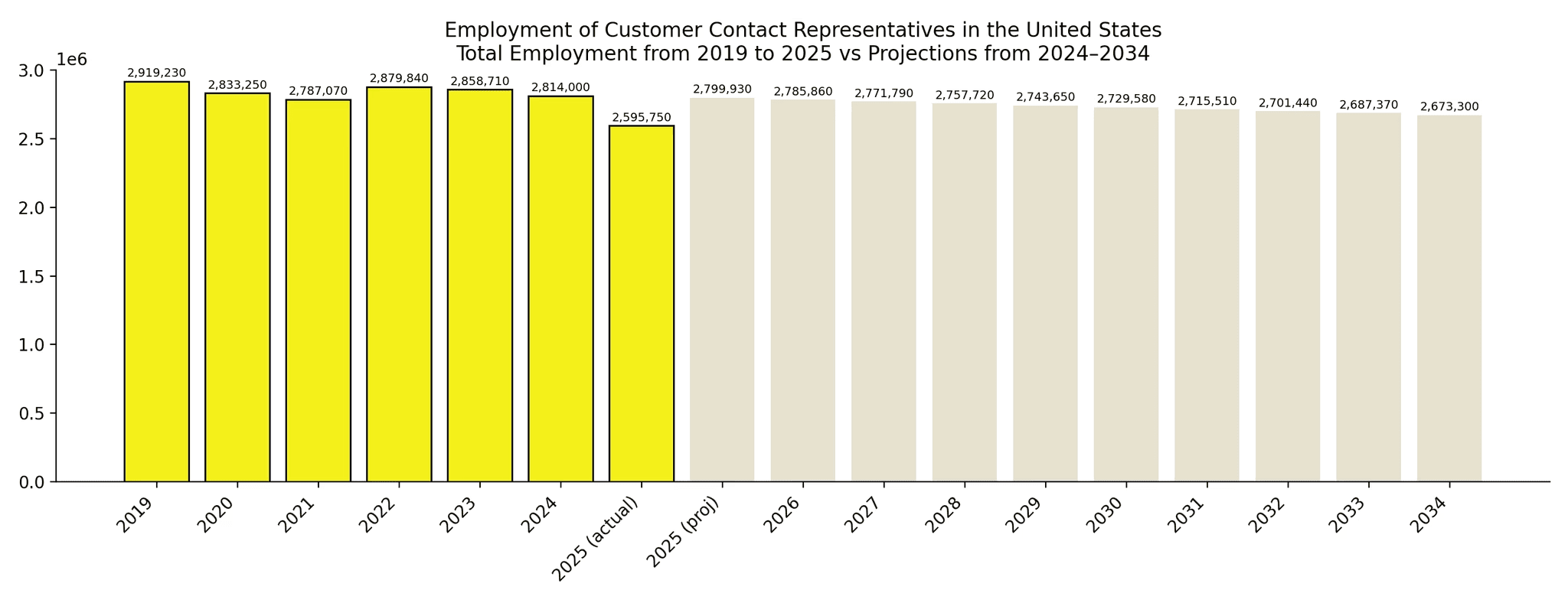
The Bureau of Labor Statistics projects employment of customer service representatives to decline 5% between 2024 and 2034. According to the 2026–27 benchmarking report from CMP Research, the group behind CCW Digital, the frontline customer contact workforce fell below that projected 2034 level in 2025: 2,595,750 people, against a projected 2,673,300 for 2034. More than 218,000 frontline roles disappeared between 2024 and 2025 alone.
The official models gave the industry a decade to absorb this shift. It took about a year.
The trust gap
Numbers like that usually come with a wave of confident technology adoption behind them. CMP found the opposite. When it surveyed contact center executives, improving agentic and generative AI ranked among the most important issues facing their operations and among the hardest to solve. Managing the change of an AI-augmented workforce sat right beside it.
CMP reads the drop as a signal that automation may be changing the workforce faster than anyone projected. The people running contact centers apparently agree, and they still don't trust the current generation of customer-facing AI products to deliver. Every sale in this category has to cross that gap.
Nobody can tell the products apart
CMP's awareness data explains some of the skepticism. The best-known tool in the category is recognized by just 42% of the buyers it's sold to, and awareness of three out of four tools falls under 20%. The takeaway is this: no one understands what vendors are selling. After years of funding and noise, even the highest profile products still draw a blank from most of the market.
Vendors own a share of that fault, according to CMP: buyers and sellers often name the same thing differently. A vendor sells an "intelligent virtual agent" or "agentic voice." The buyer is shopping for a "voicebot" to replace a tired IVR. One business function has been split across three product categories, so buyers end up guessing, and a buyer who has to guess usually stalls.
What to do with this if you run a contact center
Ignore the category names. Evaluate what a system completes on your calls, in your stack. A product that finishes an order or books an appointment is worth paying for whatever its vendor calls it. A product that can't survive a live demo on your hardest call type isn't.
Treat the workforce shift as a management problem you have now. The teams handling it well tell their people early and retrain them toward the analytical work that automation creates.
And hold vendors accountable for the trust gap. The industry's skepticism is earned, which means the burden of proof sits with vendors. Ask for named customers and real numbers, and insist on a pilot measured in days. The vendors who can't produce those are part of the reason awareness tops out at 42%.
The future of the contact center workforce stopped being a forecast. Every planning assumption downstream of that number deserves a fresh look.