Key takeaways from Omaha Steaks' fireside chat

Key takeaways from Omaha Steaks' fireside chat

Key takeaways from Omaha Steaks' fireside chat

Holden Lewis

Two years ago, Omaha Steaks hired 5,000 seasonal agents to get through the holidays. This year, the plan is 692.


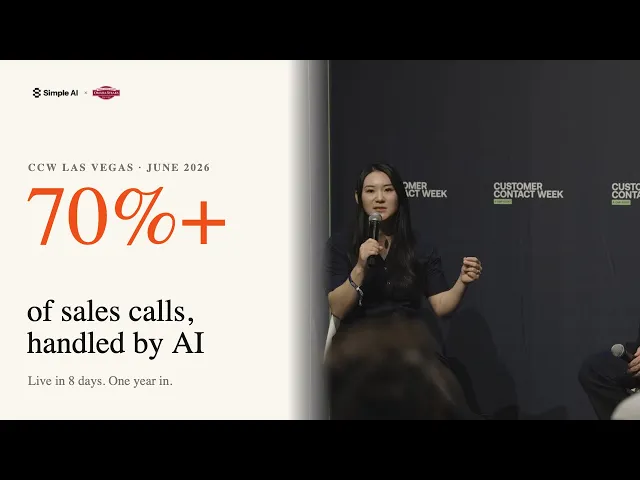
That number is the spine of the conversation our CEO Cat Li had on stage at Customer Contact Week in Las Vegas with Grant Young, Director of CEC Operations, and Rob Bradshaw, Quality Manager at Omaha Steaks. The full fireside ran 45 minutes, but we've added a 9-minute highlight reel for the masses.


The staffing math that used to run the holidays


Omaha Steaks does half its annual revenue in the few weeks around December, when call volume runs about 12x normal. Staffing for that meant hiring in September: recruit 5,000 people to net roughly 2,000 still on the phones by the time peak arrived.


Six months of building it themselves


Before Simple, the team spent six months building an IVA in-house on their CCaaS provider's tools. Grant, an analyst, and a group of developers got it to 20% containment on a single use case. It worked well enough to prove the idea and cumbersome enough to prove they shouldn't be the ones building it.


Eight days to live calls


The proof of concept with Simple was signed on June 2. By June 10, the AI was taking real customer calls on a dedicated order line: full orders placed in the system, no human on the line. Containment on day one was 52%. Grant's reaction, verbatim from the stage: "Holy shit, are we hanging up on customers?"


Meet Simone


Omaha Steaks named the agent Simone, after the Simon family that built the company. Callers hear the AI disclosure in the first sentence or two of the call. A few minutes in, plenty of them forget. They call her ma'am. One customer invited her to his daughter's birthday party.


The add-to-cart save


December 13, right at the peak of peak season. Zach, Simple's CTO, noticed a spike in callers saying the add-to-cart button on the Omaha Steaks website wasn't working, and reached out directly. At holiday volume that bug was worth millions in exposure. Omaha's team had it fixed before their QA vendor had even finished encoding the calls that would eventually have surfaced it. Nobody's contract required that call. That's the point of the story.


What about the people


Rob's QA team was about 20 people whose jobs the AI would clearly change. Omaha Steaks told them so on day one, then invested in training them toward more analytical work. Two took buyouts. Everyone else is still with the company a year later, in roles built around directing and improving the AI rather than manually reviewing calls.


The results, two years on


Call abandonment went from 16% to 9% to 3%. Seasonal hires upsold on 22% of calls; the AI runs at 30%, a 36% higher rate and level with Omaha Steaks' most experienced reps. And seasonal hiring went from 5,000 to 1,500 to a planned 692.


Watch the nine-minute reel above for the story in Grant and Rob's own words. The full 45-minute conversation is here: https://www.youtube.com/watch?v=ZCmXLwly76c

Two years ago, Omaha Steaks hired 5,000 seasonal agents to get through the holidays. This year, the plan is 692.


That number is the spine of the conversation our CEO Cat Li had on stage at Customer Contact Week in Las Vegas with Grant Young, Director of CEC Operations, and Rob Bradshaw, Quality Manager at Omaha Steaks. The full fireside ran 45 minutes, but we've added a 9-minute highlight reel for the masses.


The staffing math that used to run the holidays


Omaha Steaks does half its annual revenue in the few weeks around December, when call volume runs about 12x normal. Staffing for that meant hiring in September: recruit 5,000 people to net roughly 2,000 still on the phones by the time peak arrived.


Six months of building it themselves


Before Simple, the team spent six months building an IVA in-house on their CCaaS provider's tools. Grant, an analyst, and a group of developers got it to 20% containment on a single use case. It worked well enough to prove the idea and cumbersome enough to prove they shouldn't be the ones building it.


Eight days to live calls


The proof of concept with Simple was signed on June 2. By June 10, the AI was taking real customer calls on a dedicated order line: full orders placed in the system, no human on the line. Containment on day one was 52%. Grant's reaction, verbatim from the stage: "Holy shit, are we hanging up on customers?"


Meet Simone


Omaha Steaks named the agent Simone, after the Simon family that built the company. Callers hear the AI disclosure in the first sentence or two of the call. A few minutes in, plenty of them forget. They call her ma'am. One customer invited her to his daughter's birthday party.


The add-to-cart save


December 13, right at the peak of peak season. Zach, Simple's CTO, noticed a spike in callers saying the add-to-cart button on the Omaha Steaks website wasn't working, and reached out directly. At holiday volume that bug was worth millions in exposure. Omaha's team had it fixed before their QA vendor had even finished encoding the calls that would eventually have surfaced it. Nobody's contract required that call. That's the point of the story.


What about the people


Rob's QA team was about 20 people whose jobs the AI would clearly change. Omaha Steaks told them so on day one, then invested in training them toward more analytical work. Two took buyouts. Everyone else is still with the company a year later, in roles built around directing and improving the AI rather than manually reviewing calls.


The results, two years on


Call abandonment went from 16% to 9% to 3%. Seasonal hires upsold on 22% of calls; the AI runs at 30%, a 36% higher rate and level with Omaha Steaks' most experienced reps. And seasonal hiring went from 5,000 to 1,500 to a planned 692.


Watch the nine-minute reel above for the story in Grant and Rob's own words. The full 45-minute conversation is here: https://www.youtube.com/watch?v=ZCmXLwly76c