What California’s AB 1609 requires for AI customer service
 Yael Chen ZionContent Marketing Lead
In this article
TLDR
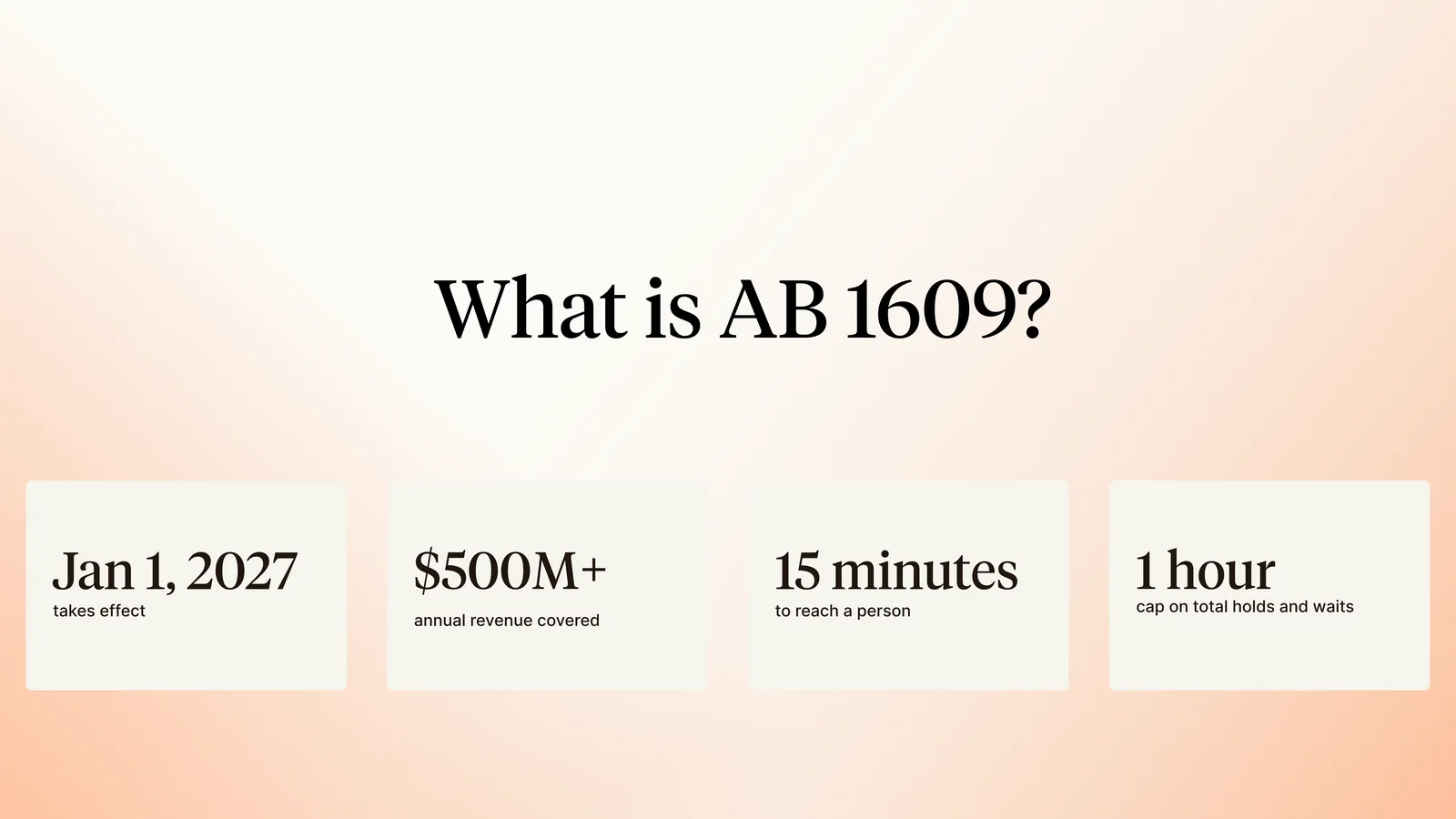
AB 1609 is a California law that takes effect on January 1, 2027. It applies to businesses with more than $500 million in annual revenue and protects customers who live in California, based on their account address. It requires those businesses to disclose when a customer could mistake their AI for a person, make asking for a human easy during business hours, connect that customer to a person within 15 minutes or book a specific time within one business day, and keep holds and waits short. It does not ban AI in customer service. We think it sets a reasonable floor, and it matches how we already build.
California’s AB 1609 takes effect on January 1, 2027, and it covers any business with more than $500 million in annual revenue that serves customers who live in California. It requires those businesses to disclose when a customer could mistake their AI for a person, to make asking for a human easy during business hours, and to make a good-faith effort to keep holds and waits short. States like Maine and Utah have focused on chatbot identity disclosures, but California’s law goes further by regulating the customer service experience itself. Since it has come up in so many conversations lately, we wanted to lay out exactly what the law says, who it covers, and where we land on it.
Who does AB 1609 apply to?
The law covers any business with more than $500 million in gross annual revenue nationally that provides goods and services to customers. That includes businesses based outside of California, and its human-access rules reach customer service across channels like phone and digital, not only the AI-powered ones.
It protects customers who live in California, and relies on the address on a customer’s account to decide who counts. A few kinds of businesses are carved out, including telecommunications and water services regulated by the California Public Utilities Commission, consumer reporting agencies, and certain hospital communications.
AB 1609 does not ban AI in customer service, and it doesn’t require a person to handle every inquiry. Companies can keep using AI as the first point of contact, they just need to do so responsibly.
What does AB 1609 require?
The law calls these systems “customer service chatbots,” and its definition is broad enough to cover voice agents like ours: any AI system with a natural language interface that gives adaptive, human-like responses and handles customer service or support. For a covered business, that comes down to five requirements.
- AI can’t pass as a person. A covered business can’t present its chatbot as human, and it has to give a clear and conspicuous disclosure when a reasonable person could be misled. The disclosure has to come in the same medium as the conversation, so a voice agent says it out loud and a chat agent says it in text.
- Asking for a human has to be easy. During regular business hours, every customer service platform needs a simple way to request a person, like a commonly understood voice command, a chat prompt, or a menu selection.
- A human has to show up quickly. When a customer asks, the business has to make a good-faith effort to connect them to a person within 15 minutes or set a specific appointment time within one business day. The 15-minute standard doesn’t apply to requests made by email, web form, or voicemail.
- Holds and waits have a limit. Once a customer is connected to a person, the business has to make a good-faith effort to keep any hold or wait to 15 minutes or less, and to keep cumulative holds, waits, and escalation queues to no more than one hour in total.
- The phone number has to be easy to find. A business that sells online and runs phone customer service has to post that number clearly on its website. A business that wasn’t offering phone service as of January 1, 2027 doesn’t have to add it, but it still needs another way for customers to promptly reach a person.
The law defines a “good faith effort” as using commercially reasonable and practicable standards designed to achieve compliance.
Who enforces AB 1609, and what are the penalties?
California prosecutors enforce the law, which means it doesn’t give customers a right to sue. Civil penalties run up to $5,000 for a first violation and $10,000 for later ones, and the law includes exceptions for unforeseen circumstances and emergencies.
How does AB 1609 fit with California’s other chatbot laws?
California already had the BOT Act, a 2019 law that makes it unlawful to use a bot to mislead people about being a bot in order to encourage a purchase or influence a vote. AB 1609 builds on it in two ways: it sets an objective disclosure standard instead of requiring proof that someone meant to deceive, and adds the requirements for reaching a human when prompted.
The other law people tend to connect to this one is SB 243, California’s companion chatbot law, which took effect on January 1, 2026. It focuses on chatbots built for ongoing personal relationships rather than those used for customer service, so doesn’t apply to the same use case.
Our take: a reasonable floor, and the way we already build
We read AB 1609 as the bare minimum, and are in support of its policies. At Simple, our mission is to make call centers run better, not worse, so a customer can always be transferred to a person during business hours, and nobody should have to say “human” over and over to get there. Our voice AI is also able to handle most of the call volume for the businesses we serve, which means human reps have shorter queues when customers do need them, and everyone gets helped quicker.
A law that pushes for productive and impactful AI in call centers lines up with what we’re already building.
What should teams check before January 1?
The useful way to prepare is to walk through the calls you already take. Does your AI say it’s AI at the start of a call? Can a customer ask for a person and be transferred, without needing to fight for it? When they ask, does someone pick up within 15 minutes, or does the customer get a specific time to be called back? Do holds, waits, and escalation queues add up to less than an hour? And is your customer service number easy to find on your website?
Disclaimer: This post is a plain-English summary and not legal advice. It’s worth checking with your counsel on how the law applies to your business. For California’s other calling rules, see our California calling laws page.