

Last week, we spent three days at Genesys Xperience in Las Vegas, talking to contact center leaders from around the world. A few themes kept coming up in booth conversations, one-on-one sessions, or during our talk. Here’s what stuck with us:
The best AI rollouts start small and expand deliberately
Integration experience is just as important as the AI itself
Voice quality is the most important part of your customer’s experience with AI

1. Starting small: crawl, walk, run
We’ve worked with contact centers of all sizes, across different industries. The teams that have the most success with implementing AI aren’t the ones trying to automate everything on day one. Rather, they start with simple wins, get familiar, and expand from there.
Crawl looks like intent based routing, FAQ handling, and basic account questions like checking a balance. It’s low risk, high reward, and pretty quick to implement.
Walk starts handling tasks like updating customer information or locating a customer’s order. The agent is still contained, but leans on more context and more complex routing.
Run is the fun stuff: placing or modifying an order, walking a customer through a lending application, or anything that touches multiple systems and real business logic. This is where AI agents become revenue powerhouses, rather than customer support un-blockers.
On the Simple team, we’re always ready to run. But if you want to build confidence and trust in your agents, this is the best way to do so.
2. Successful integration makes or breaks the customer experience
At Genesys, most contact center leaders we talked to had a similar worry: what happens when an AI agent hands off to a human? A successful handoff makes your customer’s interaction feel simpler, while a mishandled one creates a disjointed experience (even if the AI agent did everything right). A proper screen pop and warm transfer ensure your customer feels taken care of, every step of the way.
We built Simple to integrate cleanly with the tools contact centers already use, including Genesys. When a call moves from Simple’s agent to your live team, the context comes with it. Your agents aren’t starting cold, and your customers aren’t repeating their account number for the third time.
3. Voice quality is still the most important piece to the customer experience
An awkward pause, a reply that comes a beat too slow, a voice that sounds a little too perfect. It doesn’t matter how accurate your agent is if the conversation feels stilted and unnatural. We’ve found, over and over again, that voice quality is the most important aspect of truly seamless voice AI.
We recently announced our own proprietary model, Tango, that understands the natural rhythm of conversation. It knows when someone’s done talking, when they’re pausing to think, and when they’ve been interrupted. The result is an agent that responds at just the right moment, and feels intrinsically human. Read more about Tango.
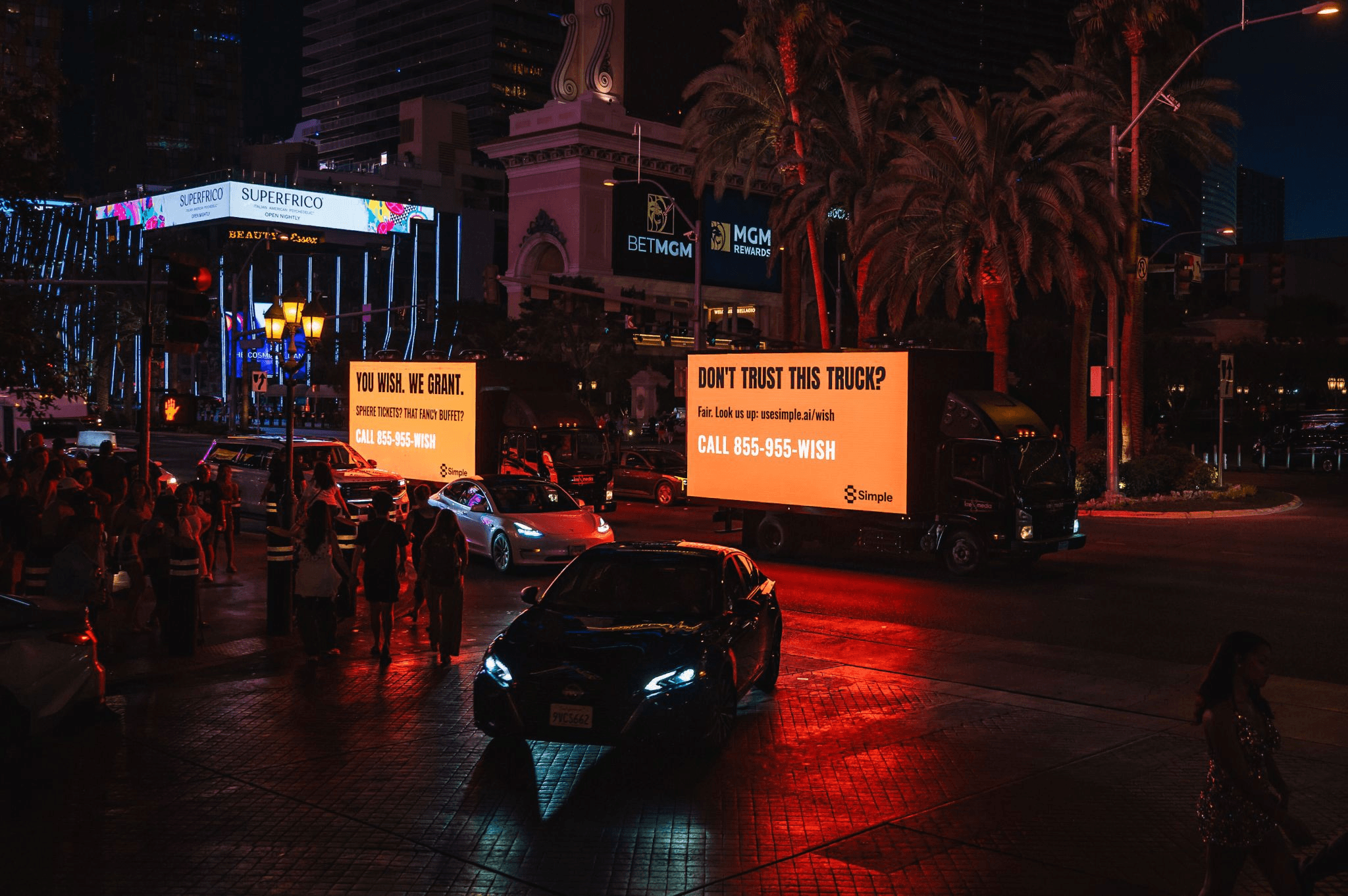
Simple Wishline, and the rest of our Genesys Xperience
If you were on the Strip during Genesys, you may have run into one of our Wishline trucks or taxis. You may have even called in, or had your wish granted! Anyone who saw our Wishline number in the wild was welcome to call in and make a wish with Wendy the Wishline Agent. Wendy took in details and the wildest of wishes (including F1 tickets and seats to an upcoming Nashville Panthers game), while showing first-hand what Simple AI’s voice agents can do.

In case you missed it, our CEO spoke to a full house about voice AI, how we build it, and how it can actually move the needle for contact centers today. She walked through the infrastructure that most people never see and the results it adds up to: a 70% resolution rate across our deployments, and higher upsell and booking conversion than live reps. Her favorite reframe of the talk: stop asking how to fix your worst agents, and start asking how to make your best agents even better. Then use AI to get everyone there.
In all of our conversations, we kept hearing how eager companies are to bring AI to their contact centers. They want to harness the power of Voice AI, but haven’t yet found the product that fits their needs. It’s the problem we’re here to solve, and all of your insights brought us that much closer. A big thanks to Genesys for an event well run, as well as everyone who stopped by our booth, made a wish, or attended my talk. I look forward to the many conversations we’ll continue to have.
Want to talk through what crawl, walk, run could look like for your team?


