
Voice AI is software that has real, spoken conversations with customers over the phone: understanding requests, responding naturally, and taking action without a script tree. Today’s AI agents are pretty extraordinary, able to handle complex flows like scheduling, sales, and customer support both accurately and reliably. On the backend, platforms combine speech recognition, language understanding, and natural-sounding speech to hold conversations that feel inexplicably human.
Why this guide exists
Voice AI often sounds a lot more complicated than it is, and can seem intimidating when you start looking for a solution for your call center. The engineering is certainly complex, but the ideas themselves aren’t hard to explain, and CX leaders shouldn’t need a computer science degree to make the right decision. This guide breaks down how voice AI actually works, and defines the terms you’ll run into while evaluating it. Plain English only.
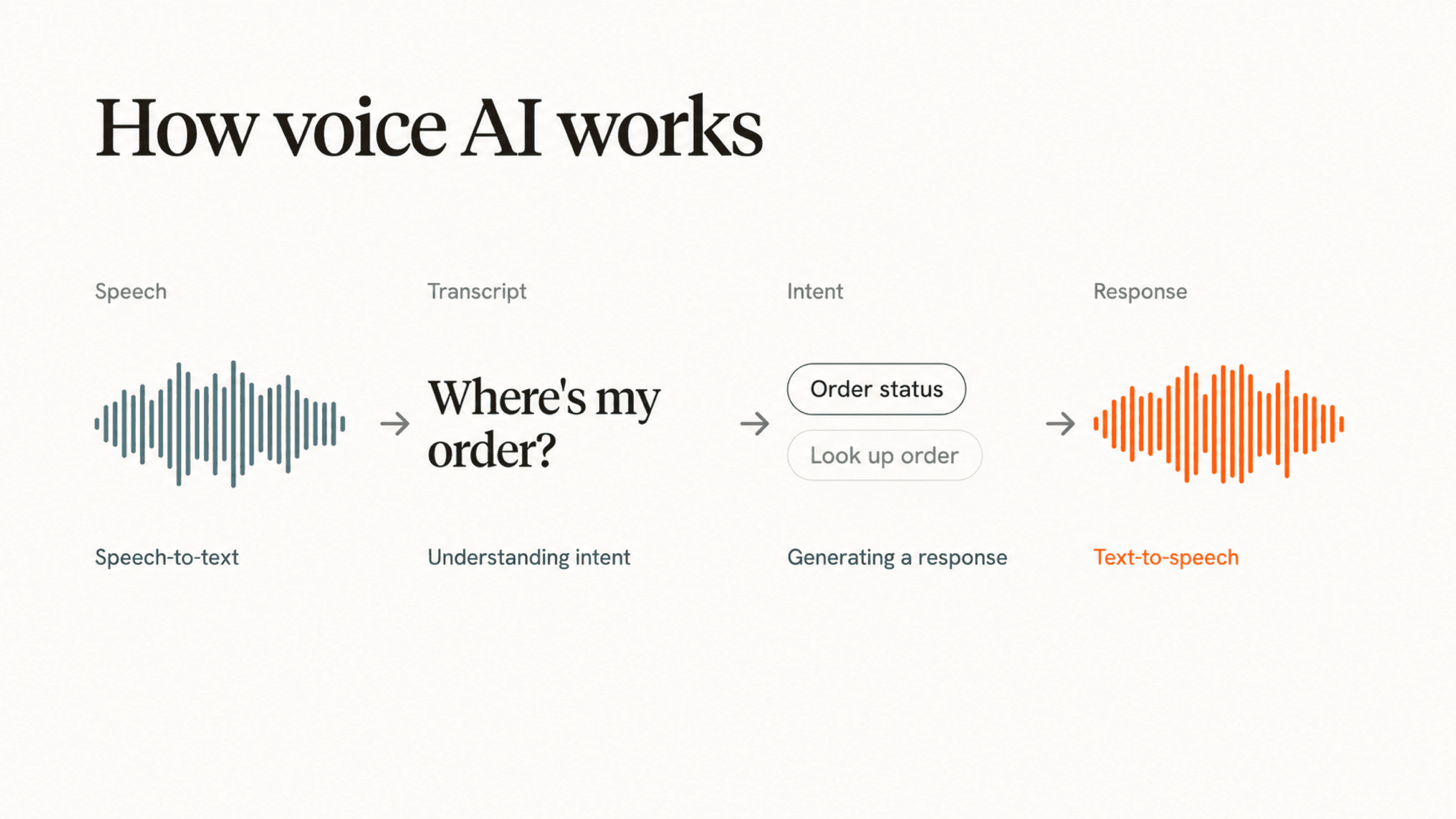
How voice AI actually works, in one pass
A customer calls into your call center, and a voice agent picks up. A few things happen next, usually in under a second:
1. Speech-to-text (transcription): the caller’s spoken words get converted into text the system can parse.
2. Understanding intent: the system identifies what the caller is calling for.
3. Generating a response: the system decides what to say or do next, whether that’s answering a question, pulling up an order, or routing to a live agent.
4. Text-to-speech: the response gets converted back into natural-sounding audio.
There’s a subtler piece stitched into this same pipeline: knowing when a caller is actually done talking. That’s called end-of-turn detection, and you’ll find more about it below.
The core vocabulary
What is containment rate?
Containment rate is the percentage of calls a voice AI resolves on its own, without transferring to a human agent. It’s the industry’s most common success metric, but it’s also inconsistently defined between vendors. Does a call that gets a wait-time message before resolving still count, and does chat volume get folded in with calls? Always confirm the exact definitions when comparing containment.
What counts as call abandonment?
Call abandonment rate is the percentage of callers who hang up before reaching a resolution, typically while waiting on hold. It’s one of the clearest signals of a broken phone experience, since every abandoned call is a customer who gave up on being helped.
What is opt-out rate?
Opt-out rate is the percentage of callers who ask for a human agent, even when the AI could have continued to help. It’s a useful companion to containment rate rather than a rival to it: containment tells you how many calls the AI handled end-to-end, while opt-out tells you how many people didn’t want it to after it had already engaged them.
What is an IVR, and why is it being replaced?
An IVR (interactive voice response) is the ‘press 1 for sales, press 2 for support’ phone-tree system most contact centers still run today. IVRs route calls based on rigid menu choices rather than understanding what a caller is actually asking for, which is why they’re increasingly being replaced by systems that let callers simply state what they need.
What is CCaaS?
CCaaS (Contact Center as a Service) is the cloud platform your team likely already uses to route calls and run day-to-day contact center operations, such as Five9, NiCE, or Genesys. Voice AI doesn’t need to replace your CCaaS to work. Most platforms plug in as an added layer that handles a slice of your call volume, while your existing system keeps doing everything else.
What’s the difference between an IVA and voice AI?
IVA (intelligent virtual agent) is an older term for the same category that voice AI now falls under, and the two are often used interchangeably. If a vendor or an RFP brings up IVA, they’re almost always describing the same kind of system this guide covers.
What makes an AI agent ‘agentic’ vs. scripted?
A scripted bot follows a fixed decision tree, while an agentic AI system can reason through a conversation, pull in outside information, and take multi-step actions. The practical difference between the two shows up when a caller goes off-script: a flowchart bot breaks, while an agentic system can still follow the conversation.
What is NLU?
NLU (natural language understanding) is the technology that lets a system figure out what a caller actually means, beyond the words they used. It’s what helps your agent realize that ‘where’s my order’ and ‘I never got my package’ have the same intent, even though the sentences barely overlap.
What’s a warm transfer?
A warm transfer hands a call from AI to a human agent along with full context, so the caller never has to repeat themselves. A cold transfer, with no context passed along, is one of the most common reasons callers get frustrated with automated systems. Warm transfers help customers feel taken care of, and make the experience seamless even when an AI agent can’t handle the entire flow themselves.
What is end-of-turn detection?
End-of-turn detection is how a voice AI system knows a caller is actually finished talking, not just pausing to think. If your agent waits too long to speak, the conversation feels stilted and robotic; if it jumps in too early, it interrupts the caller mid-sentence. This is one of the areas where voice AI performance differs, and is a metric systems are frequently graded on.
What is barge-in?
Barge-in is when a caller interrupts AI mid-sentence, requiring it to stop speaking and listen instead of finishing its own line. Handling barge-in well is one of the clearest tells that you’re talking to a system built for real conversation, as opposed to a recording with a menu attached.
What is voice AI latency, and why does it matter?
Latency is the delay between when a caller finishes speaking and when the AI responds, measured in milliseconds. Anything much above 800ms starts to feel unnatural to a caller, even if they can’t articulate why. It’s one of the most underestimated factors in whether a voice AI system feels like talking to a person or talking to a machine.
What is RAG?
RAG (retrieval-augmented generation) is a technique where an AI system looks up relevant information from a knowledge base in real time before generating its response, rather than relying only on what it was trained on. This is what lets a voice AI agent answer accurately when asked about an order status, current inventory, or company policies.
What is SOC 2, and why does it matter for voice AI vendors?
SOC 2 is an independent audit that verifies a company has real controls in place for data security, availability, and confidentiality. For a voice AI vendor handling customer calls, often including payment or account details, a SOC 2 report is one of the first things a security or compliance reviewer will ask for.
What is WISMO, and why do contact centers care?
WISMO stands for ‘where is my order,’ and is the single most common call type for any business that ships physical goods. It’s cited constantly in contact-center benchmarks because it’s high-volume, low-complexity, and one of the easiest call types to automate well.
What is knowledge-based authentication?
Knowledge-based authentication verifies a caller’s identity by confirming details only they should know, such as an order number, billing ZIP code, or date of birth, before an agent shares account information. This is often established for both human and AI agents, and is a standard security layer for any call that touches personal or account data.
Three ways companies build voice AI
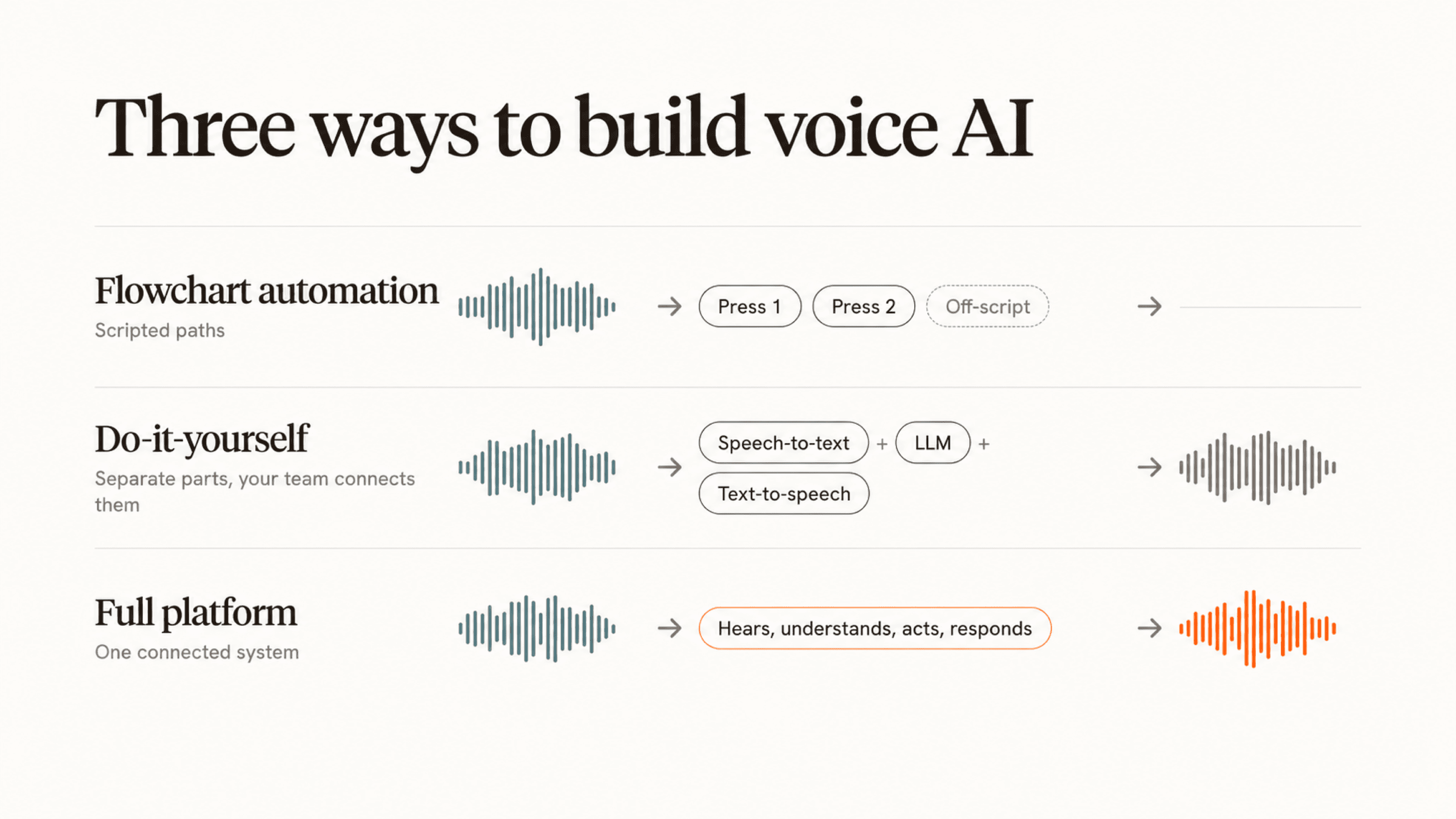
Not every voice AI system is built the same way. Here are the three most common approaches.
1. Flowchart-style automation
Flowchart-style automation layers voice on top of the same logic as a traditional IVR: a caller’s words trigger the next branch in a decision tree, rather than being genuinely understood. It’s the fastest and cheapest option to stand up, but breaks the moment a caller says something the script didn’t anticipate.
2. Do-it-yourself infrastructure
Do-it-yourself infrastructure means assembling your own system from individual pieces: a speech recognition provider, a language model, a text-to-speech engine, and the plumbing to connect them. This gives you full control over every part of the stack, but also means your team owns integration work, latency tuning, and any ongoing maintenance that comes with running in production.
3. Full conversational platforms
Full conversational platforms handle the entire pipeline—recognition, understanding, response, and voice—as one connected system, along with the orchestration and analytics layered on top. The tradeoff is less granular control over any single piece, in exchange for not having to build or maintain the pipeline yourself. Some companies, like Simple, offer bespoke deployments that make sure the system you’re implementing answers all of your business needs.
None of these options are universally right. The best fit usually comes down to how much engineering time your team wants to spend on the voice AI itself, and the complexity of the problem you’re trying to solve.
Why teams start looking at voice AI in the first place
Voice AI isn’t right for every contact center. But a few situations come up again and again for teams that truly benefit from it.
Call volume spikes hard during specific seasons or hours. If your busiest weeks mean hiring and training a wave of temporary agents, only to scale back down a few months later, you know how expensive, time-consuming, and ineffective the process is. Voice AI can operate at scale for contact centers handling seasonal volume.
Callers hang up before they get help. A high call abandonment rate, especially during peak hours, usually means people are giving up after waiting too long for a live agent. It signals more than just a bad experience: it’s a missed sale or an unresolved issue. AI agents help reduce hold times, and ensure your abandonment rate reduces alongside it.
A huge share of calls are the same simple question, asked constantly. ‘Where’s my order’ is the classic example: high-volume, low-complexity, and one of the easiest call types to automate well. Having voice AI handle these requests frees up live agents for callers who actually need them.
Nobody can answer the phone after hours. Missed calls outside business hours are lost opportunities that competitors with round-the-clock coverage don’t have to give up. If a potential customer calls after hours, voice AI can still pick up. It can book the appointment, close the sale, or answer the question instead of sending them to voicemail.
You don’t fully trust your own numbers. If getting a straight answer on your containment rate means reconciling two dashboards or a spreadsheet someone still updates by hand, that’s usually a sign the underlying reporting needs attention. This is often the moment teams start looking at their contact center stack more broadly.
If a few of these sound familiar, it’s worth a closer look. These are the exact problems voice AI is built to solve.
Wrapping up
Voice AI sounds complicated because of the vocabulary, not the ideas. Containment, latency, agentic, WISMO: once you know what these terms actually mean, vendor conversations get a lot easier to follow.
We created this guide to make sure you’re never nodding along to a term you don’t actually understand. Bookmark it, come back to it, and, if this sounds like the right solution for you, reach out to the Simple team for a demo.


