
Most pieces of a voice agent can be bought off the shelf today. Speech-to-text, large language models and text-to-speech are each a few API calls away and can be wired to a phone line without much trouble. So when a consumer brand starts thinking about putting AI on its sales line, building in-house can look like the obvious move. Why pay a partner for something your own engineers could put together?
At Simple AI, we build voice AI agents that sell in the contact centers of consumer brands like Omaha Steaks, Speedway Motors, and Renewal by Andersen. Getting an AI to speak out loud might feel simple. Getting it to reply as fast as a person would, on a noisy phone line, without talking over your customer, is one of the hardest engineering problems in voice AI. We’ve hired the best engineers to solve it, and that’s why our voices are considered some of the best in the industry. But voice quality is only where the work starts. The real revenue impact of voice AI comes from what the agent does once the conversation is going: recognizing a returning customer and what they bought last time, changing an order inside your systems while they wait, and texting them a week later when they’re ready to buy. That’s where the gap between building and buying gets even wider.
Should you build or buy voice AI?
In the simplest terms: if you need voice AI to drive revenue, buy it. Selling means looking up orders, writing to your CRM, taking payments and following up across phone, text and email until the sale closes. Each of those steps has the agent working in the systems your business runs on, with a customer counting on it to get things right.
Even a use case that sounds simple, like answering common questions or routing callers to the right team, takes more than it seems. The agent still has to sound human and get every answer right, and your team still needs QA on every call, structured data pulled from every conversation, and reporting it can act on. Each of those is hard to build in-house. Many of our customers start with a single use case like this and expand as their teams see what else Simple can do.
For Epiq, Simple handles calls about legal settlements and class actions: checking whether someone is eligible, verifying their details, and helping when they’ve forgotten a PIN. On paper, it’s an FAQ line. Epiq still ran a bake-off against multiple vendors and chose Simple for the best voice quality and response times, and the most accurate answers. Since going live, their team has used Simple to test every change in simulation, get a daily report on every escalated call, and keep an audit log of every change to their agents. None of that comes with a voice model and a phone line.
In practice, build vs. buy covers three options. The leanest connects a voice model straight to your phone system. Next are self-serve platforms, where your team configures and runs a capable agent on its own. The most complete is a partner that builds the agent with you: integrating with your contact center platform (CCaaS) and CRM, giving your team tools to run it, and staying hands-on through deployment. We built Simple to be the third option, because the closer an agent gets to a sale, the more integration, testing and upkeep it needs behind it.
Option | What it is | Who does the work |
|---|---|---|
Build in-house | Connect a voice model straight to your phone system | Your engineers build, test and maintain everything: conversation timing, integrations, customer memory, security, QA and reporting |
Self-serve platform | Your team configures and runs a capable agent on its own | Your team configures, runs and maintains the agent |
Partner that builds with you | A partner builds the agent with you, integrates with your CCaaS and CRM, and stays hands-on through deployment | You bring knowledge of your business; the partner brings the AI expertise and the tools to run it |
What does it take to build voice AI that drives revenue?
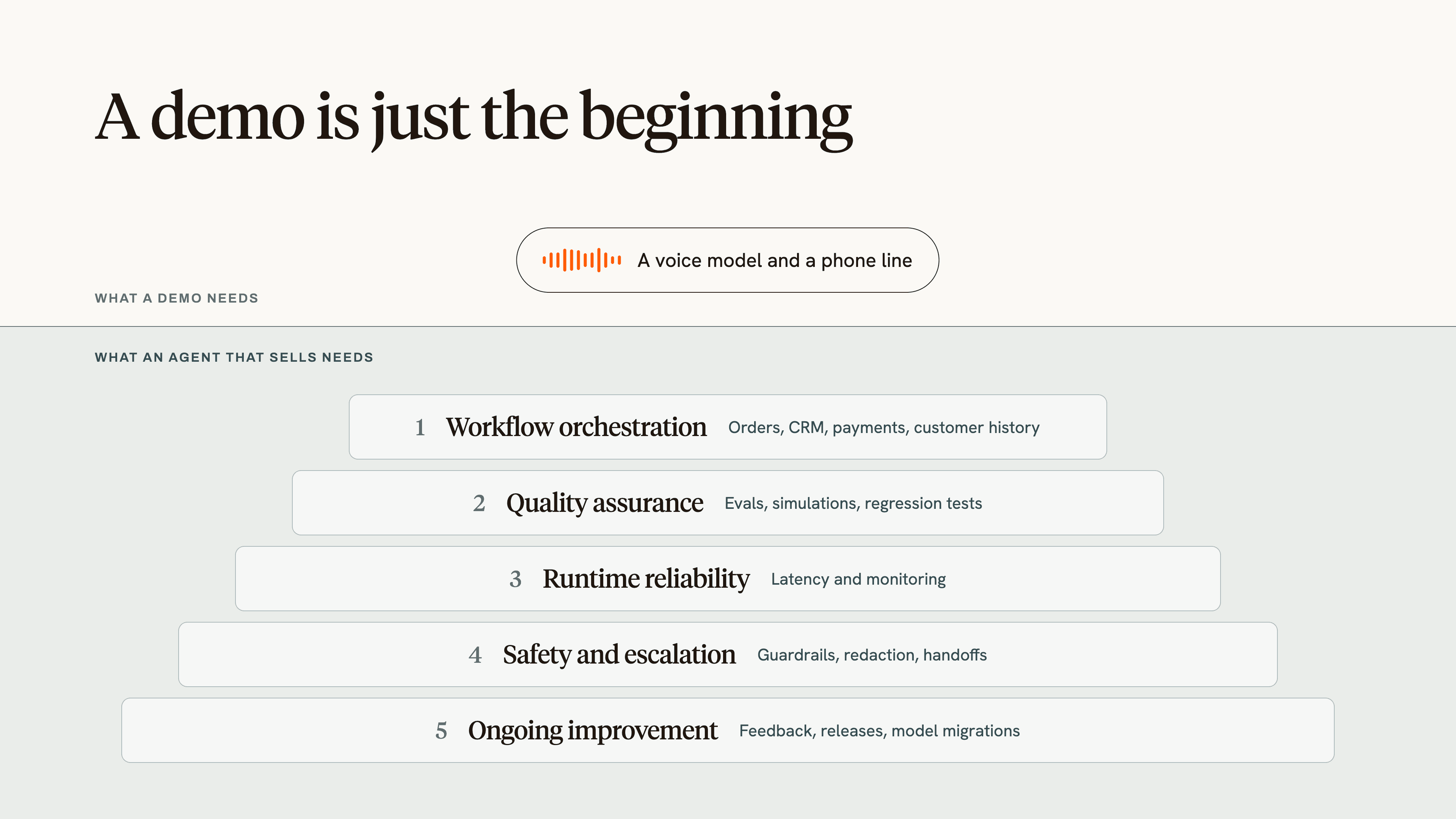
Building voice AI that drives revenue takes far more than a speech model and a phone line. Your team would need to build real-time conversation timing, integrations with your contact center and CRM, customer memory, security redaction, simulation testing, QA and reporting, and then maintain all of it as models change. If you decide to build, you might think you just need to find a text-to-speech model and link it to your phone line. The real to-do list looks a little more like this:
Choose speech-to-text, language and text-to-speech models, and benchmark each one on real phone audio
Chain them together fast enough that callers never notice a gap
Teach the agent to tell a finished thought from a pause, and a “mm-hmm” from an interruption
Tune every model for speakerphones, background noise and bad connections
Connect to your CCaaS, CRM, order management and payment systems
Give the agent a memory of every customer interaction across phone, text and email
Set rules for when the agent follows up, and on which channel
Mask and redact card numbers and personal data on every call, then prove it to a security review
Build a tool so people outside engineering can update offers, scripts and policies
Build simulations that test every change before it reaches a customer
Build QA that tags calls, tracks outcomes and compares AI agents against human ones
Pull structured data out of every conversation and send it where your team needs it
Monitor live calls and catch failures before your customers do
Re-test everything each time a model provider ships a new version
And that’s just to launch! Every month your team spends working through that list is a month of sales your agent isn’t closing. None of it is something your engineers can put together on the side.
What your voice AI needs to drive sales
A voice AI agent that sells needs six things: conversation that moves at human speed, a memory of every customer, tools your team can use without engineers, built-in measurement, security for card and personal data, and a team working on it full time. Each is covered below.
1. A conversation that moves at human speed
In a study of conversations across 10 languages, researchers found that people typically leave a gap of around 200 milliseconds between turns. To come close, a voice agent has to run three models back to back: one to transcribe what the customer said, one to decide how to respond, and one to say it out loud. That reply then has to travel across a phone network. Every handoff adds a delay that then gets passed on to your customer. In development, we found that the smartest models are often the slowest, while the fastest are the hardest to keep accurate. An agent that’s both quick and right takes a pipeline tuned as a whole, not the best model for each step.
On a sales call, timing does a lot of quiet work. Customers interrupt, pause mid-thought to check a measurement, and nod along to show they’re still listening. An AI agent has to make those same decisions continuously, working out whether the customer has finished speaking or is just catching their breath. Get it wrong in one direction and the agent talks over someone who was about to say yes. On the other? The line goes quiet long enough to make the whole experience feel stilted and robotic.
We’ve built a pipeline around the calls customers actually make, whether on speakerphone, in the car, or with a TV going in the background, and we trained our own end-of-turn model, Tango, to tell a finished thought from a pause. A customer halfway through an order shouldn’t have to repeat themselves.
2. A memory of every customer
The best sales associates remember their customers. They know your size, which piece you’ve had your eye on, and call the day it comes in. That level of attention has mostly been found in luxury stores, where every customer gets a person’s time. With AI, larger companies can now give it to them.
To do that, an agent has to remember each customer’s history, contact them at the right moment on the channel they prefer, and keep the conversation going across phone, text and email for as long as the journey takes. That means connecting it to every system that holds your customer data, and deciding when it should reach out, not only how it should respond.
For JG Wentworth, Simple guides applicants through a multi-step application by phone and text, and keeps following up for days until it’s complete. For Empire Today, Simple stays with each customer from before the purchase to long after the floors go in: answering questions up front, confirming the consultation and the installation, and following up months later about the next room. In both cases, the sale takes more than one conversation, and the agent remembers each one.
3. Tools for the people who run the agent
Say your team decides to run a promotion with your voice AI agent. It needs to know the offer, mention it to the right customers, and answer questions about it correctly from the first call. If each of those changes goes through an engineering ticket, the agent ends up a step behind the business it’s supposed to be growing.
Building your own agent means building a second product as well: a way for people outside engineering to update the agent safely, and simulations that test every change before it reaches a customer. Simple comes with both, so the people who know your customers best can make those changes themselves.
4. Measurement that fits how you already work
Putting AI on the phones doesn’t change what you need to know. What share of calls end in a purchase? Where do customers drop off? Is the new script converting better than the old one? You need those answers for your AI agents the same way you need them for your people.
Getting them takes a measurement layer on top of the agent, and in Simple, that layer comes standard. Teams can tag calls, track outcomes, and compare performance across AI agents, AI versions and human agents in one place. Some of our customers now route their human agents’ calls into Simple just to use our analysis tools, which tells us the measurement is worth having on its own.
5. Security you can stand behind
Sales calls carry card numbers, account details and personal information. Masking and redacting that data on every call, without exception, and proving it to a security review takes specialized work, and the requirements keep changing. We handle it across every deployment, so your team doesn’t have to take it on.
6. A team that works on it full time
None of the work above is ever truly finished. Customers find new ways to ask for things, your business keeps changing what it needs the agent to do, and the models underneath change constantly. Model providers ship new versions every week, and each one has to be benchmarked on everything your agent does, from understanding a caller to analyzing a call to striking the right tone, before it’s safe to put in front of a customer. Inside a consumer brand, all of that competes for engineering time with the website, app and everything else on the roadmap.
Our team works on voice AI agents 100% of the time. That’s far more bandwidth than most companies could set aside for a single internal project, and each improvement we make reaches all of our customers. We test every new release against our own benchmarks and run whichever performs best, whether it comes from a model provider or from the self-hosted and self-trained models we run ourselves, like Tango. Your agent gets the best performance money can buy, with no overhead for your engineers.
What do you get when you buy?
When you buy from a partner that builds with you, you get to revenue sooner, start with a pipeline already proven on live sales calls, work with voice AI experts, and pay with pricing tied to outcomes. Here is what that means in practice.
Revenue sooner. Our dedicated deployment team can stand up a new use case in days.
A head start. The pipeline behind every Simple agent reflects everything we’ve learned on live sales calls, and we upgrade it every time a better model ships. You start from there, instead of from zero.
Experts who build it with you. Simple isn’t a do-it-yourself platform. We invest heavily in discovery, integrate with the CCaaS and CRM systems you already use, and configure every agent around your workflows and the numbers your team is measured on. You bring the knowledge of your business and we bring the AI expertise. No one has to learn the other’s job.
Incentives that match yours. Our pricing is tied to outcomes, so we only do well when your agent does.
For Omaha Steaks, that meant far fewer customers hanging up before anyone could help them. After they deployed Simple, their call abandonment rate dropped from 16% to 0%.
When does building your own voice AI make sense?
Building makes sense when voice AI is itself your product, or when you have a dedicated voice engineering team and a use case that no partner can support. In those cases, owning the stack can be worth the cost, but for a brand that wants voice AI to grow sales, it rarely is.
Making the call
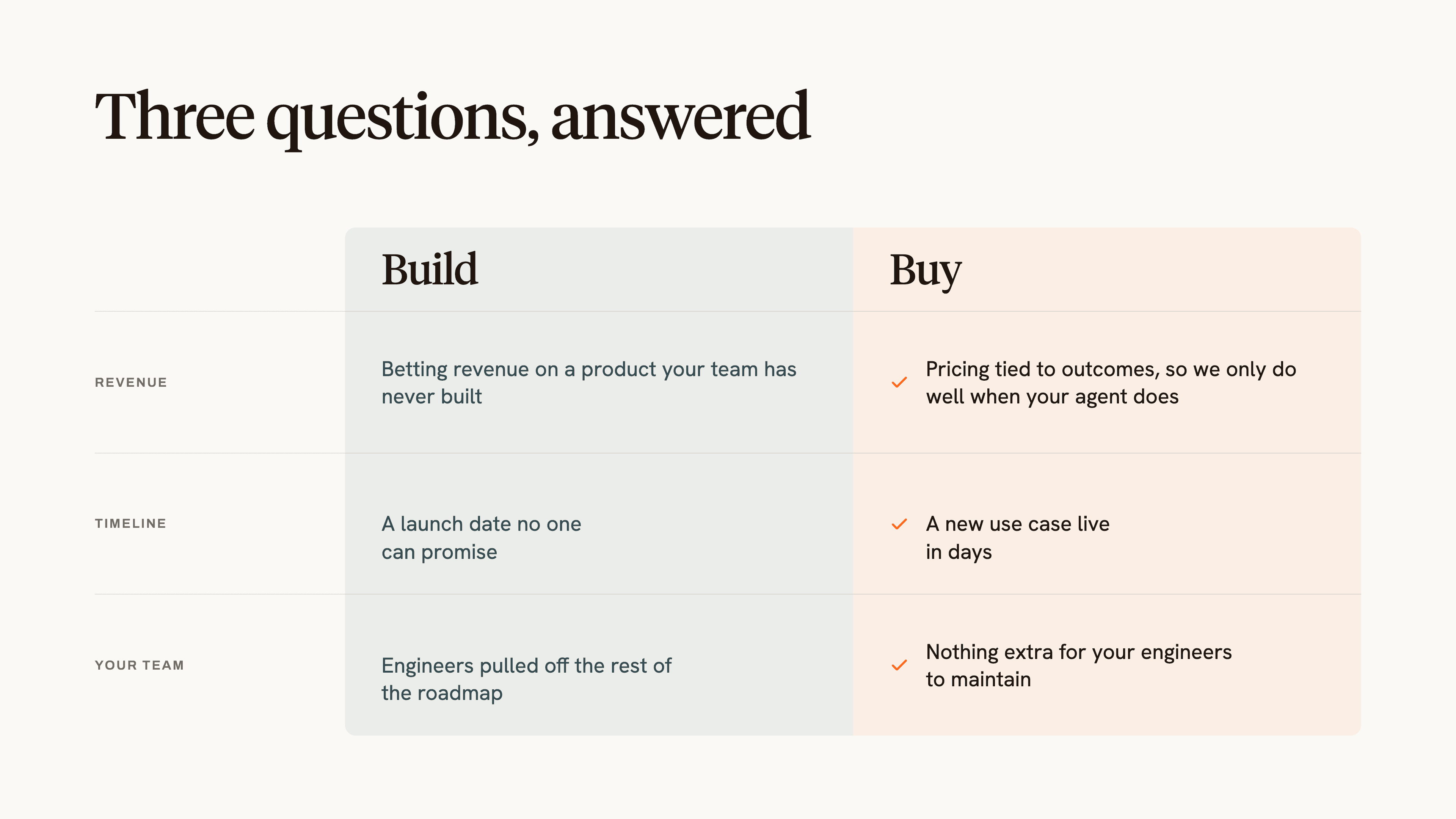
Any AI investment has to answer the same three questions: will it grow revenue, how soon will it do so, and how much will it ask of your team? Building your own voice AI puts all three at risk. You’d be betting revenue on a product your team has never built, on a timeline no one can promise, with engineers pulled away from everything else on the roadmap. A partner whose whole team works on this can answer all three now.
If revenue, performance and customer experience matter to your business, the choice is clear. Buy.
We built Simple so consumer brands can give every customer the kind of attention that used to belong to luxury stores, without having to become AI companies to do it. We take on the hard parts, from timing a reply to following up months later, so your team can spend its time on your customers.
Schedule a demo with our team to see what that looks like for your business.